Born Sarah Breedlove, Madam C.J. Walker was a wildly successful business woman who overcame the Reconstruction Era limitations put on African Americans to become the first female millionaire. Part businesswoman, part philanthropist, part activist, Madam Walker and her company gave education and well-paying jobs to thousands of African American women, and left a legacy of education and self-sufficiency that still survives today.
Sarah was born in December of 1867 in Delta, Louisiana on the same plantation her parents and elder siblings had been enslaved on. Sarah was the first of her family to be born free and grew up against the shaky and uncertain background of the post-Civil War South. Her parents, though technically free, were unable to leave the plantation because of a lack of funds and the "Black Codes", laws that restricted the movements of African Americans. They and their children kept working in the cotton fields, and Sarah was put to work helping them at a young age.
Though Sarah's mother, Minerva Breedlove, would have liked for her daughter to attend school, African Americans of the era were still not alloted all the rights of white Americans. Schools were segregated, and black schools were frequently burned, and teachers harrassed or killed. Furthermore, in 1873, the year Sarah would have started first grade, the Louisiana state legislature refused to fund public schools, and the schools in Sarah's parish, as well as many others, shuttered. Because of this, Sarah was unable to get a formal education, a problem Sarah would attempt to remedy throughout most of her life.
An unfortunate fact of Sarah's life is that she was never very lucky. This bad luck started off in 1873 when Minerva died. Sarah's father, Owen Breedlove, remarried, but he passed in 1875 when Sarah was only seven. The exact natures of their deaths are unknown, but it is supposed that they, along with many others, were carried off by the cholera or yellow fever epidemics that swept the South. The Breedloves died leaving six children orphans.
It was difficult to find work in Delta, and so the family, one by one, left for Vicksburg, Mississippi, not far from where Sarah and her younger brother, Solomon, were living with their elder sister, Louvenia, and her husband, Jesse. Sarah's older brothers, unable to find work, gradually headed west to St. Louis, Missouri, leaving Sarah at the mercy of her brother in law. Jesse was a violent and abusive man who resented Sarah, and to escape him, Sarah married Moses McWilliams. She was only fourteen.
Sarah was notoriously tight-lipped about her past, and not much is known about her marriage with Moses. From Sarah's telling of it, it was a strictly pragmatic move on her part, born out of a desire for her own home rather than true love. Regardless, they had one child together, Lelia, who would be more or less the center of Sarah's life until her death.
Bad luck struck again, and in 1888, Moses died. Like with Sarah's parents, the cause of death has been lost to time, though the popular legend is that he was among the 95 victims of lynching in Mississippi that year. This claim is more or less refuted by A'lelia Bundles, Sarah's great-great-granddaughter, citing evidence that these claims originated from people who didn't know Moses, long after Sarah's death. There are other claims that Moses died in a work accident, but if there was any official documentation in the matter, it has been lost to history. Irregardless, he left Sarah a widow with a two year old child to support.
Sarah had been working as a laundress in Vicksburg, and she and Moses had been just barely scraping by. With the loss of Moses's income, there was no way Sarah could survive in Vicksburg, and there was no chance for improvement in Mississippi, so Sarah went to St. Louis to join her brothers.
Alexander, James, and Solomon Breedlove were all working as barbers when Sarah and Lelia joined them in 1889. At the time being a barber was a prestigious profession for an African American man, and Sarah's brothers enjoyed reasonable prosperity. Through familial association, Sarah was undoubtedly able to learn things that would greatly assist her in the haircare business later.
Finding a job was difficult, especially as a single mother. The only work Sarah was able to find was as a live-in-maid to a wealthy white family, a job that would not allow her to keep Lelia with her. Though it undoubtedly broke her heart, Sarah put Lelia in an orphanage, on the arrangement that Lelia would not be put up for adoption, and worked tirelessly for about a year until she had enough saved up to start her own business as a laundress. Lelia rejoined her, and she was able to send her daughter to school.
In 1894, Sarah married again, this time to John Davis, a ne'er-do-well who had a drinking problem and a bit of fluff on the side. Almost immediately, their marriage soured as Davis was brazenly unfaithful, and refused to work. He was brought up before the courts several times, which undoubtedly humiliated Sarah, who worked tirelessly to create a good reputation for herself and her daughter.
Not much is known about this second marriage, because, as with so much of the unsavory bits of Sarah's past, she attempted to have all mentions of it expunged. However, it is very telling that pair had to move several times, and in 1899, Lelia attended school only 23 times, despite the fact that she had attended school almost religiously the year before and would do the same after. By 1903, the pair had separated for good, and Sarah had begun seeing Mr. Charles Joseph Walker, an ad man and reporter for the local black newspapers.
In 1900, Sarah had, with the help of her church friends, started attending night classes. Sarah was ambitious, she wanted to move up in the world, and, having rubbed elbows with the middle class in church attendance, she was determined to become a respectable and affluent person in her own right. She just wasn't sure how to go about it.
Sarah attended the 1904 World's Fair in St. Louis, and there she attended meetings and lectures given by some of the most prominent black leaders of the day, including Booker T. Washington and W. E. B. Du Bois. Their talk of civil rights and their determination to end lynching inspired Sarah, but she was very intimidated by them, due to her lack of wealth and appearance.
Like many women of the era, Sarah was going bald. Poor nutrition and lack of access to clean water for washing had led to a scalp infection, which had caused her hair to break off and caused her to develop bald spots. Sarah tried a multitude of remedies, and in 1903, Sarah found a solution, Annie Pope Turnbo's Miracle Hair Grower. Not only did this ointment help Sarah regrow her hair, but she also began to work as a door-to-door saleswoman for the company.
In 1905, Sarah moved again, this time to Denver. Lelia was at boarding school in Tennessee, and it was growing ever more difficult to make a living as a Turnbo Saleswoman in St. Louis. The market was oversaturated with Turbo products, and there was no real path to advancement for Sarah. However, rumors were that Denver was hell on the hair. So once again she packed her bags, and arrived in Denver with $1.50 in her pocket and a bag of hair products to sell.
Luckily, Sarah had family in Denver. Her sister-in-law and three nieces lived in the booming mine town, and Sarah was able to rely on her for support while she found her feet. Sarah found work as a cook in a boarding house and made friends with the local pharmacist, Edmund Scholtz.
Pharmacists at the time were just as much mad scientist as pill counters, and Scholtz helped Sarah analyze the ingredients of her Turnbo hair products so that Sarah could add and take away from the creams and create her business. Sarah likely took him up on the offer, and in 1905, she rented a small attic she used as a laboratory, mixing up hair remedies to try on herself and her nieces.
Sarah would later claim that the idea and recipes for her products would come to her in a dream, but this can be easily dismissed as self-aggrandizing nonsense and was about par for the course in Sarah's attempt to sugarcoat her past. Without the contributions of Edmund Scholtz and Annie Turnbo, Sarah would never have gotten anywhere.
She continued to sell Turnbo hair products, as well as other soaps and cures made up by local companies. By 1905, Sarah had saved up enough to quit her cooking job, and she set up a hair salon, giving hair treatments and selling products first Ms. Turnbo's, then her own. Though she still took in washing two days a week, she began to make money off her own business.
Sarah had still been seeing Charles Walker, though, given the distance, their relationship was likely more "off again" than "on again". However, in late 1905, he joined Sarah in Denver, and they were married on January 4, 1906.
Charles was a businessman as well, and he joined ship. Though their relationship would end up as tumultuous as Sarah's previous relationship, he made two major contributions to Sarah's business. He suggested that she add a mail-order element to her business model, and he suggested that she rebrand her products as "Mrs. C.J. Walker". Sarah took these ideas and ran with them. She hired her daughter and nieces to run the mail-order arm of her company and branded her products under the name "Madam C.J. Walker", a name invoking all the refinement of a French salon.
Though she was selling well in Denver, Sarah wanted to expand. Against her husband's protests, she left Lelia in charge of the mail-order side of business and went on a sales and lecture tour of the Rocky Mountain and Southern states to gain brand recognition, promote her "Walker Method" of grooming, and increase sales. She began to advertise in prominent black newspapers, taking the extraordinary leap of using pictures of herself for her before and after shots in advertisements. This lent her extra credibility because then, as now, advertisers would often use pictures of two completely different people in their before and after pictures.
Her business was growing to an almost unmanageable point, so Sarah decided to move from Denver which, while a good city, was not the bustling trade hub Sarah needed. In 1907, Sarah moved her company to Pittsburgh, a major transport hub that would drastically reduce Sarah's shipping costs. Sarah opened up a factory and started making her products on a wider scale.
Most importantly, while in Pittsburgh Sarah opened up the Lelia College of Beauty Culture to train the thousands of "hair culturists" that sold her products. In this school, Sarah not only taught sales strategies but also taught how to give hair treatments and how to dress hair. Her goal for her hair culturists was that they would not only sell products, but also sell the women they served on a lifestyle of cleanliness and style. Sarah firmly believed that being clean and well-groomed was as much a secret to success as hard work, and she wanted to spread her secret to as many of her sisters as she could.
Sarah was a devout woman, and her faith informed her business practices. The churches she belonged to stressed charitable action, and Sarah believed that it was her duty to not only do charity but to also raise her employees up with her and give them the opportunity to make a better life for themselves and their families. Sarah's school gave African-American women the skills they needed to start their own businesses and paid well enough that the children of her employees were able to attend school, something still rare for the era.
Throughout her career, Sarah employed more than 10,000 black women, and their average pay was between $15 and $40 a week, about $430--$1,148 in 2019 currency. She extended this pay level to not only her skilled saleswomen but to her less skilled factory workers as well. Sarah was known for being a good and generous employer throughout her life.
Pittsburgh was never the intended final resting place of Sarah's business, and in 1910, she moved to Indianapolis where she incorporated. Indianapolis was, at the time, the crossroads of America, and contained a thriving black business community. She opened another factory there, as well as another beauty school, and started to rake in the cash.
The year of her move to Indianapolis Sarah "divorced"¹ Walker. He had never been content being her subordinate, and had been unfaithful to Sarah. He attempted several times to counterfeit her products but was never successful. Though she was no longer technically "Mrs. C.J. Walker", Sarah kept the name because it was inextricably mixed up with her brand.
Sarah stopped personally overseeing her company in 1913, leaving operations to be managed by Lelia. She turned her attention to philanthropy, giving generous sums to the YMCA, retirement homes, convalescent homes, and orphanages. She sponsored at least six students at the Tuskegee Institute and provided scholarships for several black women to attend schools of higher learning. She made charitable giving a part of her company culture and encouraged her employees to get involved in charity. Upon her death, Sarah willed two thirds of her net worth to charity, including giving the NAACP the $5,000 ($143,622 in 2019 currency) they would need to stay afloat during the Great Depression.
Not content to remain a philanthropist, Sarah took up activism as well. Sarah had had strong political opinions since her encounters at the 1904 world fair not a decade before. As a prosperous woman, Sarah felt she finally had something to bring to the table. She joined the NAACP, and helped organize the "Silent Protest" of 1917. She encouraged her employees to get involved on a local level.
Interestingly, Sarah clashed with the most influential civil rights leader of the time--Booker T. Washington. Sarah's usage and promotion of the hot comb--an early hair straightener--caused Washington to accuse her of attempting to whitewash black women. This combined with the perceived frivolity of the beauty industry caused Washington to dismiss Sarah as a business leader, despite the fact that she frequently sought his approval. However, as Sarah grew more influential and inspiration in black business circles he grudgingly gave her his respect.
Sarah moved to New York in 1914 with the intention to rest. A life of struggle and stress had left Sarah with hypertension and nephritis. Sarah's version of "rest" wasn't very restful, however, and she continued her activism and philanthropy. In May of 1919, she died of kidney disease.
If we're talking about people who pulled themselves up by their bootstraps, Sarah Breedlove Walker is foremost among them. Where so many people who claim to be "self-made" have come from incredibly privileged backgrounds, Sarah started with nothing and through hard work and determination, she pulled herself out of poverty to create a company that would not only give her daughter a better life, but would also create a better life for her thousands of employees, and their children. Sarah's determination to lift up her community has left an immeasurable impact on the African American community
¹We put "divorced" in air quotes, because when Sarah went to divorce Charles, she discovered that she had never gotten around to divorcing John Davis, which meant Sarah had been living as a bigamist for four years.
This article was edited by Mara Kellogg.
Sources
On Her Own Ground: the Life and Times of Madam C.J. Walker by A'lelia Bundles
Madam C.J. Walker: Inventor, Entrepreneur, Millionaire by Mary N. Olounye
Madam C.J. Walker-Biography
Madam C.J.Walker-Official Website
Madam C.J. Walker-National Women's History Museum
Madam C.J. Walker-Encyclopedia Britannica
Madam C.J. Walker's Philanthropy
Madam C.J. Walker-Archbridge Institute
Madam C.J. Walker-The History Chicks
Currency Conversion
 |
| Sarah Breedlove |
Though Sarah's mother, Minerva Breedlove, would have liked for her daughter to attend school, African Americans of the era were still not alloted all the rights of white Americans. Schools were segregated, and black schools were frequently burned, and teachers harrassed or killed. Furthermore, in 1873, the year Sarah would have started first grade, the Louisiana state legislature refused to fund public schools, and the schools in Sarah's parish, as well as many others, shuttered. Because of this, Sarah was unable to get a formal education, a problem Sarah would attempt to remedy throughout most of her life.
An unfortunate fact of Sarah's life is that she was never very lucky. This bad luck started off in 1873 when Minerva died. Sarah's father, Owen Breedlove, remarried, but he passed in 1875 when Sarah was only seven. The exact natures of their deaths are unknown, but it is supposed that they, along with many others, were carried off by the cholera or yellow fever epidemics that swept the South. The Breedloves died leaving six children orphans.
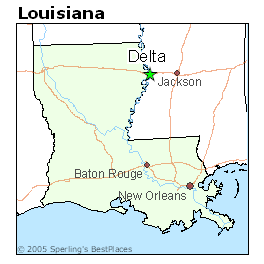 |
| Delta, Louisiana |
Sarah was notoriously tight-lipped about her past, and not much is known about her marriage with Moses. From Sarah's telling of it, it was a strictly pragmatic move on her part, born out of a desire for her own home rather than true love. Regardless, they had one child together, Lelia, who would be more or less the center of Sarah's life until her death.
Bad luck struck again, and in 1888, Moses died. Like with Sarah's parents, the cause of death has been lost to time, though the popular legend is that he was among the 95 victims of lynching in Mississippi that year. This claim is more or less refuted by A'lelia Bundles, Sarah's great-great-granddaughter, citing evidence that these claims originated from people who didn't know Moses, long after Sarah's death. There are other claims that Moses died in a work accident, but if there was any official documentation in the matter, it has been lost to history. Irregardless, he left Sarah a widow with a two year old child to support.
Sarah had been working as a laundress in Vicksburg, and she and Moses had been just barely scraping by. With the loss of Moses's income, there was no way Sarah could survive in Vicksburg, and there was no chance for improvement in Mississippi, so Sarah went to St. Louis to join her brothers.
 |
| A'lelia would go on to become a major figure in the Harlem Renaissance. |
Finding a job was difficult, especially as a single mother. The only work Sarah was able to find was as a live-in-maid to a wealthy white family, a job that would not allow her to keep Lelia with her. Though it undoubtedly broke her heart, Sarah put Lelia in an orphanage, on the arrangement that Lelia would not be put up for adoption, and worked tirelessly for about a year until she had enough saved up to start her own business as a laundress. Lelia rejoined her, and she was able to send her daughter to school.
In 1894, Sarah married again, this time to John Davis, a ne'er-do-well who had a drinking problem and a bit of fluff on the side. Almost immediately, their marriage soured as Davis was brazenly unfaithful, and refused to work. He was brought up before the courts several times, which undoubtedly humiliated Sarah, who worked tirelessly to create a good reputation for herself and her daughter.
Not much is known about this second marriage, because, as with so much of the unsavory bits of Sarah's past, she attempted to have all mentions of it expunged. However, it is very telling that pair had to move several times, and in 1899, Lelia attended school only 23 times, despite the fact that she had attended school almost religiously the year before and would do the same after. By 1903, the pair had separated for good, and Sarah had begun seeing Mr. Charles Joseph Walker, an ad man and reporter for the local black newspapers.
 |
| 1904 World's Fair |
Sarah attended the 1904 World's Fair in St. Louis, and there she attended meetings and lectures given by some of the most prominent black leaders of the day, including Booker T. Washington and W. E. B. Du Bois. Their talk of civil rights and their determination to end lynching inspired Sarah, but she was very intimidated by them, due to her lack of wealth and appearance.
Like many women of the era, Sarah was going bald. Poor nutrition and lack of access to clean water for washing had led to a scalp infection, which had caused her hair to break off and caused her to develop bald spots. Sarah tried a multitude of remedies, and in 1903, Sarah found a solution, Annie Pope Turnbo's Miracle Hair Grower. Not only did this ointment help Sarah regrow her hair, but she also began to work as a door-to-door saleswoman for the company.
In 1905, Sarah moved again, this time to Denver. Lelia was at boarding school in Tennessee, and it was growing ever more difficult to make a living as a Turnbo Saleswoman in St. Louis. The market was oversaturated with Turbo products, and there was no real path to advancement for Sarah. However, rumors were that Denver was hell on the hair. So once again she packed her bags, and arrived in Denver with $1.50 in her pocket and a bag of hair products to sell.
 |
| Annie Pope Turnbo would rebrand many times, but her products eventually became known under the name Poro. |
Pharmacists at the time were just as much mad scientist as pill counters, and Scholtz helped Sarah analyze the ingredients of her Turnbo hair products so that Sarah could add and take away from the creams and create her business. Sarah likely took him up on the offer, and in 1905, she rented a small attic she used as a laboratory, mixing up hair remedies to try on herself and her nieces.
Sarah would later claim that the idea and recipes for her products would come to her in a dream, but this can be easily dismissed as self-aggrandizing nonsense and was about par for the course in Sarah's attempt to sugarcoat her past. Without the contributions of Edmund Scholtz and Annie Turnbo, Sarah would never have gotten anywhere.
She continued to sell Turnbo hair products, as well as other soaps and cures made up by local companies. By 1905, Sarah had saved up enough to quit her cooking job, and she set up a hair salon, giving hair treatments and selling products first Ms. Turnbo's, then her own. Though she still took in washing two days a week, she began to make money off her own business.
Sarah had still been seeing Charles Walker, though, given the distance, their relationship was likely more "off again" than "on again". However, in late 1905, he joined Sarah in Denver, and they were married on January 4, 1906.
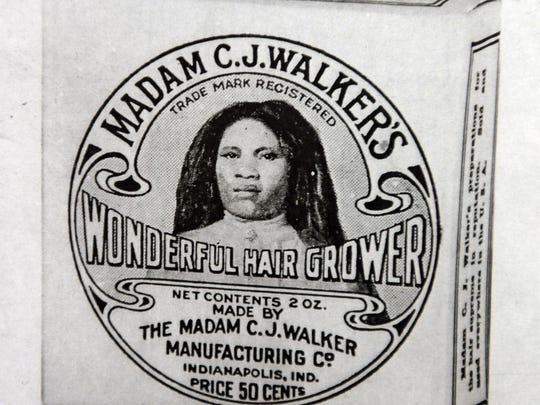 |
| Sarah's first product line included three products. The 'Wonderful Hair Grower' was one of them. |
Charles was a businessman as well, and he joined ship. Though their relationship would end up as tumultuous as Sarah's previous relationship, he made two major contributions to Sarah's business. He suggested that she add a mail-order element to her business model, and he suggested that she rebrand her products as "Mrs. C.J. Walker". Sarah took these ideas and ran with them. She hired her daughter and nieces to run the mail-order arm of her company and branded her products under the name "Madam C.J. Walker", a name invoking all the refinement of a French salon.
Though she was selling well in Denver, Sarah wanted to expand. Against her husband's protests, she left Lelia in charge of the mail-order side of business and went on a sales and lecture tour of the Rocky Mountain and Southern states to gain brand recognition, promote her "Walker Method" of grooming, and increase sales. She began to advertise in prominent black newspapers, taking the extraordinary leap of using pictures of herself for her before and after shots in advertisements. This lent her extra credibility because then, as now, advertisers would often use pictures of two completely different people in their before and after pictures.
Her business was growing to an almost unmanageable point, so Sarah decided to move from Denver which, while a good city, was not the bustling trade hub Sarah needed. In 1907, Sarah moved her company to Pittsburgh, a major transport hub that would drastically reduce Sarah's shipping costs. Sarah opened up a factory and started making her products on a wider scale.
Most importantly, while in Pittsburgh Sarah opened up the Lelia College of Beauty Culture to train the thousands of "hair culturists" that sold her products. In this school, Sarah not only taught sales strategies but also taught how to give hair treatments and how to dress hair. Her goal for her hair culturists was that they would not only sell products, but also sell the women they served on a lifestyle of cleanliness and style. Sarah firmly believed that being clean and well-groomed was as much a secret to success as hard work, and she wanted to spread her secret to as many of her sisters as she could.
Sarah was a devout woman, and her faith informed her business practices. The churches she belonged to stressed charitable action, and Sarah believed that it was her duty to not only do charity but to also raise her employees up with her and give them the opportunity to make a better life for themselves and their families. Sarah's school gave African-American women the skills they needed to start their own businesses and paid well enough that the children of her employees were able to attend school, something still rare for the era.
 |
| After shuttering in 1981, Sarah's manufacturing plant became the 'Madam Walker Theatre' |
Throughout her career, Sarah employed more than 10,000 black women, and their average pay was between $15 and $40 a week, about $430--$1,148 in 2019 currency. She extended this pay level to not only her skilled saleswomen but to her less skilled factory workers as well. Sarah was known for being a good and generous employer throughout her life.
Pittsburgh was never the intended final resting place of Sarah's business, and in 1910, she moved to Indianapolis where she incorporated. Indianapolis was, at the time, the crossroads of America, and contained a thriving black business community. She opened another factory there, as well as another beauty school, and started to rake in the cash.
The year of her move to Indianapolis Sarah "divorced"¹ Walker. He had never been content being her subordinate, and had been unfaithful to Sarah. He attempted several times to counterfeit her products but was never successful. Though she was no longer technically "Mrs. C.J. Walker", Sarah kept the name because it was inextricably mixed up with her brand.
Sarah stopped personally overseeing her company in 1913, leaving operations to be managed by Lelia. She turned her attention to philanthropy, giving generous sums to the YMCA, retirement homes, convalescent homes, and orphanages. She sponsored at least six students at the Tuskegee Institute and provided scholarships for several black women to attend schools of higher learning. She made charitable giving a part of her company culture and encouraged her employees to get involved in charity. Upon her death, Sarah willed two thirds of her net worth to charity, including giving the NAACP the $5,000 ($143,622 in 2019 currency) they would need to stay afloat during the Great Depression.
Not content to remain a philanthropist, Sarah took up activism as well. Sarah had had strong political opinions since her encounters at the 1904 world fair not a decade before. As a prosperous woman, Sarah felt she finally had something to bring to the table. She joined the NAACP, and helped organize the "Silent Protest" of 1917. She encouraged her employees to get involved on a local level.
 |
| The Villa Lewaro, in Harlem. Sarah took the name for her home from the name of her daughter, Lelia Walker Robinson |
Sarah moved to New York in 1914 with the intention to rest. A life of struggle and stress had left Sarah with hypertension and nephritis. Sarah's version of "rest" wasn't very restful, however, and she continued her activism and philanthropy. In May of 1919, she died of kidney disease.
If we're talking about people who pulled themselves up by their bootstraps, Sarah Breedlove Walker is foremost among them. Where so many people who claim to be "self-made" have come from incredibly privileged backgrounds, Sarah started with nothing and through hard work and determination, she pulled herself out of poverty to create a company that would not only give her daughter a better life, but would also create a better life for her thousands of employees, and their children. Sarah's determination to lift up her community has left an immeasurable impact on the African American community
¹We put "divorced" in air quotes, because when Sarah went to divorce Charles, she discovered that she had never gotten around to divorcing John Davis, which meant Sarah had been living as a bigamist for four years.
This article was edited by Mara Kellogg.
Sources
On Her Own Ground: the Life and Times of Madam C.J. Walker by A'lelia Bundles
Madam C.J. Walker: Inventor, Entrepreneur, Millionaire by Mary N. Olounye
Madam C.J. Walker-Biography
Madam C.J.Walker-Official Website
Madam C.J. Walker-National Women's History Museum
Madam C.J. Walker-Encyclopedia Britannica
Madam C.J. Walker's Philanthropy
Madam C.J. Walker-Archbridge Institute
Madam C.J. Walker-The History Chicks
Currency Conversion